⭐⭐⭐⭐⭐ 1000+ Google Trusted Reviews | 📧 info@pestcontroldubai247.com

Landlord Refusing Pest Control in Dubai? Your Rights Under RERA Tenancy Law (2026)
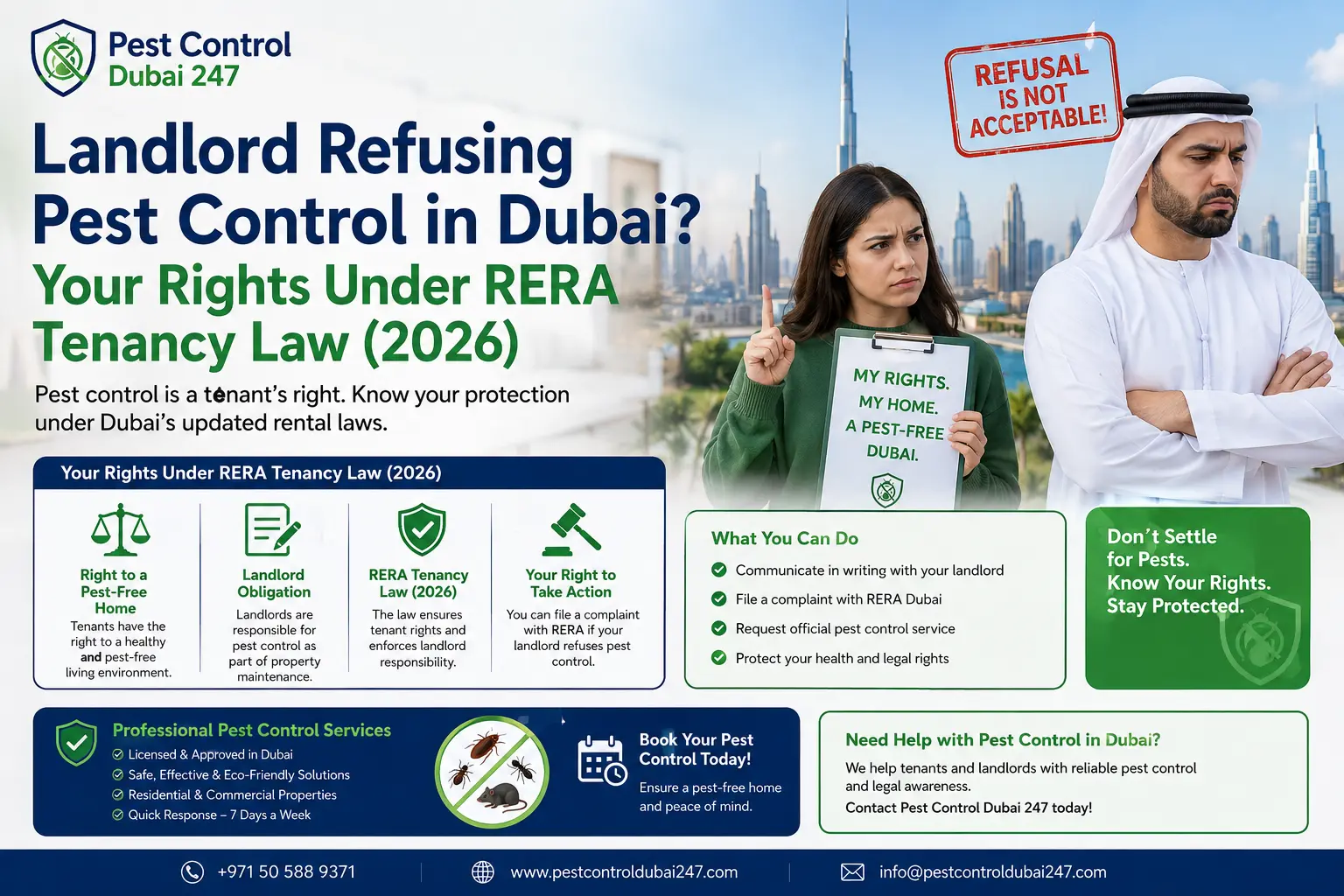
You’ve reported the cockroaches three times. You’ve sent photos of the bed bug bites. And your landlord’s response ranges from “just buy a spray” to complete silence. If this sounds familiar, you’re one of thousands of Dubai tenants stuck in the same standoff every year and most of them don’t know that Dubai tenancy law is actually quite clear about whose problem this is.
As a pest control company, we’re often the neutral party in the middle of these disputes called by tenants, paid by landlords (or fought over by both). This guide explains exactly what Dubai’s tenancy law says, when the landlord must pay, when it’s genuinely your responsibility, and the step-by-step escalation path when a landlord refuses to act.
Disclaimer: This article is general information based on publicly available Dubai tenancy legislation, not legal advice. For your specific situation, consult a legal professional or the Rental Disputes Centre.
What Dubai Tenancy Law Actually Says
Dubai tenancies are governed by Law No. 26 of 2007 (as amended by Law No. 33 of 2008). Three articles matter for pest disputes:
Article 15 requires the landlord to hand over the property in a condition that allows you the full intended use of it. A flat with an active cockroach or bed bug infestation on day one fails that standard.
Article 16 makes the landlord responsible, throughout the tenancy, for maintenance and for fixing any defect that affects your intended use of the property “unless otherwise agreed by the parties.” That last phrase is critical, and we’ll come back to it.
Article 17 holds the landlord liable for any defect, damage, or deficiency not caused by the tenant’s fault.
Put simply: the default position of Dubai law is that keeping the property habitable including free of infestations you didn’t cause is the landlord’s job.
So Who Pays for Pest Control – Landlord or Tenant?
This is where real-world disputes happen, because the honest answer is: it depends on the cause. Here’s the breakdown that reflects both the law and how disputes are typically assessed:
Landlord’s responsibility ✅
- Infestation present at handover if pests appear within the first days or weeks of moving in, the property wasn’t delivered in habitable condition (Article 15). This is why we always advise documenting the unit’s condition on day one something we covered in detail in our guide on pest control certificates for Ejari & DEWA move-in, where we explain why asking for the handover treatment report protects you.
- Building-fabric infestations cockroaches entering through shared drainage, garbage chutes, and service risers are a building infrastructure issue, not a housekeeping issue. This is extremely common in high-rise towers; we broke down exactly how this happens in our article on cockroaches coming from kitchen drains in Dubai Marina high-rises.
- Structural pest issues termites are always a structural/building matter. No tenant behaviour causes termites; they enter through the slab and soil, as we explained in our termite inspection checklist for villa buyers.
- Infestations spreading from neighboring units you cannot control the hygiene of the flat next door.
Tenant’s responsibility ⚠️
- Infestations clearly caused by your own living habits accumulated food waste, long-neglected cleaning, keeping conditions that attract pests.
- If your signed contract explicitly assigns pest control to you remember Article 16’s “unless otherwise agreed” clause. Many Dubai contracts shift minor maintenance (commonly small repairs under a set amount) to tenants, and some specifically name pest control. Read your contract before starting a dispute it determines your starting position.
- Bed bugs you introduced for example, brought in luggage after travel. In practice, proving who introduced bed bugs is difficult, which is why these become the most contested pest disputes in shared accommodations a problem we explored in our tenant’s guide to bed bugs in Dubai bed spaces and partition rooms.
The grey zone 🤔
Seasonal pest pressure like the summer surge when heat drives cockroaches and ants indoors across every building in Dubai see our guide to summer pest problems in Dubai is often argued both ways. The practical resolution: one-off treatments in a well-kept unit lean toward the landlord; repeat infestations in a unit with hygiene issues lean toward the tenant.
What to Do When Your Landlord Refuses
Follow this order each step builds the evidence file you’ll need if it escalates:
Step 1: Document everything (start today)
- Photos and videos of pests, droppings, bites, and affected areas with timestamps
- Keep a sighting log: date, time, location in the flat
- Photograph the cleanliness of your unit too this pre-empts the “tenant hygiene” counter-argument
Step 2: Notify the landlord in writing
WhatsApp messages count, but email creates a cleaner record. State the problem, attach photos, reference that the infestation affects your use of the property, and request professional treatment within a reasonable deadline (7 days is standard; 48 hours for severe bed bug or rodent situations). Polite but formal.
Step 3: Follow up once, in writing
If ignored, send one follow up referencing the first notice and stating that you will escalate to the Rental Disputes Centre if unresolved. A surprising number of landlords act at this exact point the mention of RDC changes the conversation.
Step 4: Get a professional inspection report
An inspection report from a Dubai Municipality approved pest control company documenting the species, severity, and importantly the likely source of the infestation (building drainage, neighbouring unit, structural entry points) is the strongest piece of evidence you can hold. It transforms “tenant says vs landlord says” into a technical finding. We provide these inspection reports with clear source assessments, and they’re regularly used in deposit and maintenance disputes.
Step 5: File a complaint at the Rental Disputes Centre (RDC)
The RDC, under the Dubai Land Department, is the official body for tenancy disputes. You’ll need your Ejari, tenancy contract, Emirates ID, your written notices, and your evidence file. Filing fees are calculated as a percentage of the annual rent (approximately 3.5%, subject to minimum and maximum limits — confirm current fees with the RDC). Outcomes can include ordering the landlord to carry out treatment, compensation, or rent adjustments depending on the case.
What NOT to do
- Don’t withhold rent non-payment can be used against you regardless of the pest issue. Dubai law does not recognise unilateral rent withholding as a remedy.
- Don’t abandon the property without an RDC ruling breaking a lease over pests requires the dispute process, not a midnight move-out.
- Don’t delay reporting if you live with an infestation for months before complaining, it weakens the argument that it predates you or comes from the building.
Can You Break Your Lease Over a Pest Infestation?
Not unilaterally. If the infestation is severe, persistent, and the landlord refuses to act despite documented notices, you can petition the RDC to terminate the contract on grounds that the property is not fit for its intended use. Success depends entirely on your evidence trail which is exactly why Steps 1-4 above matter. Tenants who documented from day one and hold a professional inspection report walk into the RDC with a case; tenants with only verbal complaints walk in with a story.
The Fastest Practical Resolution (What We See Work)
Legal escalation takes time. In our experience treating hundreds of disputed units across Dubai Marina, JLT, Deira, and International City, the fastest resolution is usually this: the tenant obtains a professional inspection report identifying the source, shares it with the landlord alongside a treatment quote, and proposes a split or landlord payment based on what the report shows. Most landlords faced with a technical report pointing to building drainage or a neighbouring unit pay rather than face the RDC. The dispute that looked immovable resolves in a week.
Facing a Pest Problem Your Landlord Won’t Fix?
Pest Control Dubai 247 provides same-day inspections with written source assessment reports across all Dubai communities the document that turns your complaint into a case. And when treatment is approved, our DM-approved, child and pet-safe treatments come with a 6-month warranty. Available 24/7. Contact us on WhatsApp for an inspection booking.
Frequently Asked Questions
Is the landlord responsible for pest control in Dubai?
By default, yes Articles 15–17 of Law No. 26 of 2007 make the landlord responsible for delivering and maintaining a habitable property, which includes infestations not caused by the tenant. However, Article 16 allows contracts to reassign responsibilities, so your signed tenancy contract can shift pest control to you. Always check your contract first.
My contract says I’m responsible for all maintenance. Do I still have rights?
Contract clauses shifting minor maintenance to tenants are common and generally enforceable. However, disputes often distinguish between routine upkeep and serious habitability issues (severe infestations, structural pest problems like termites). The RDC assesses each case on its facts which is why documentation and a professional source-assessment report matter so much.
How much does it cost to file a rental dispute in Dubai?
RDC filing fees are calculated as a percentage of the annual rent approximately 3.5%, subject to minimum and maximum limits. Confirm the current fee schedule directly with the Rental Disputes Centre before filing.
Can I do the pest control myself and deduct it from rent?
No deducting from rent without landlord agreement or an RDC ruling is risky and can put you in breach. The safer route: written notice, professional inspection report, negotiation, and RDC if needed.
Who pays for bed bug treatment in a rental?
The most contested pest question in Dubai. If bed bugs were present at move-in or spread from adjacent units, the landlord’s side is strong. If you introduced them (travel, second-hand furniture), it’s yours. A professional inspection assessing infestation age and spread pattern is often the deciding evidence.
How fast must a landlord respond to a pest complaint?
The law doesn’t set a fixed number of days, but the standard practice is a “reasonable period” commonly interpreted as around 7 days for standard issues and faster for severe health-affecting infestations. Your written notice should state a clear deadline.
